ASIL
An agent-native interface for software-operating agents that replaces screenshot-and-click control with structured state and semantic actions.
Problem
GUI agents are often bottlenecked by the human-facing screenshot-and-click loop: screenshots expose incomplete state, while low-level GUI events make long-horizon software workflows brittle.
Key Contributions
- Framed software operation as an interface problem and designed ASIL around structured observations, semantic actions, and evaluator-backed checks.
- Built a unified JSON observation-action protocol across 15 applications using six file-backed, native-script, command, and service-level realization patterns.
- Developed a semi-automated onboarding framework for interface qualification, adapter generation, static audit, host probing, and Docker probing.
- Studied ASIL as both an inference-time interface and a training substrate for supervised and reinforcement-learning workflows.
Results
- Accepted to Findings of EMNLP 2026.
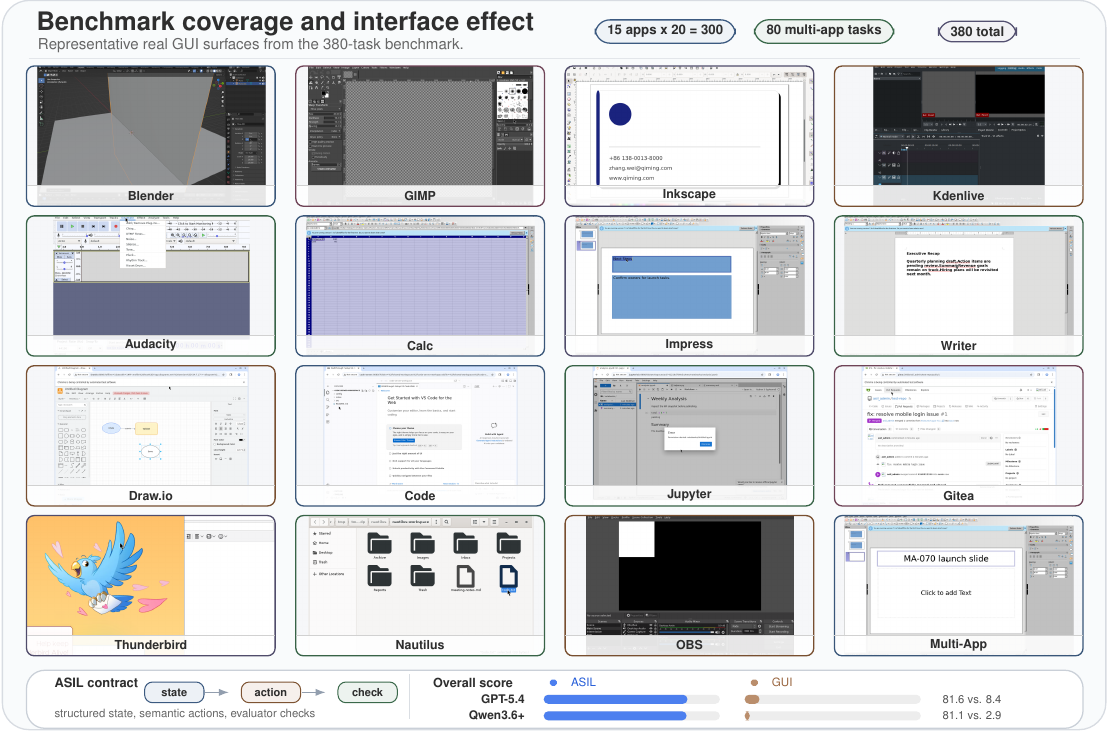
- Evaluated 300 single-application and 80 multi-application tasks across 15 real applications.
- GPT-5.4 scored 81.6 with a 15-action ASIL budget versus 6.6 for screenshot GUI control with 50 steps under shared tasks and validators.
- ASIL SFT and RL raised Qwen3.5-2B from 58.0 to 74.4 and Qwen3.5-9B from 66.6 to 82.2.
Interface question
ASIL starts from a simple observation: many agent failures in software are not only reasoning failures, but interface failures. Screenshots compress software state into pixels, and clicks stretch semantic intent into fragile event sequences.
What we built
The project exposes software through structured state, semantic actions, and direct evaluator checks. Fifteen application adapters use the deepest feasible access path - structured files, native scripts, commands, or service APIs - while keeping one observation-action protocol for the agent. A semi-automated onboarding framework turns reviewed interface evidence into extension candidates, then qualifies, audits, and probes them before use.
Evidence
Across 380 tasks, closed models exceed 80 while using fewer than five actions per task. On matched tasks, GPT-5.4 reaches 81.6 under a 15-action ASIL budget versus 6.6 for screenshot GUI control under 50 steps. The same structured traces support SFT and evaluator-backed on-policy RL, raising Qwen3.5-9B from 66.6 to 82.2. ASIL was accepted to Findings of EMNLP 2026.