MatToolBench
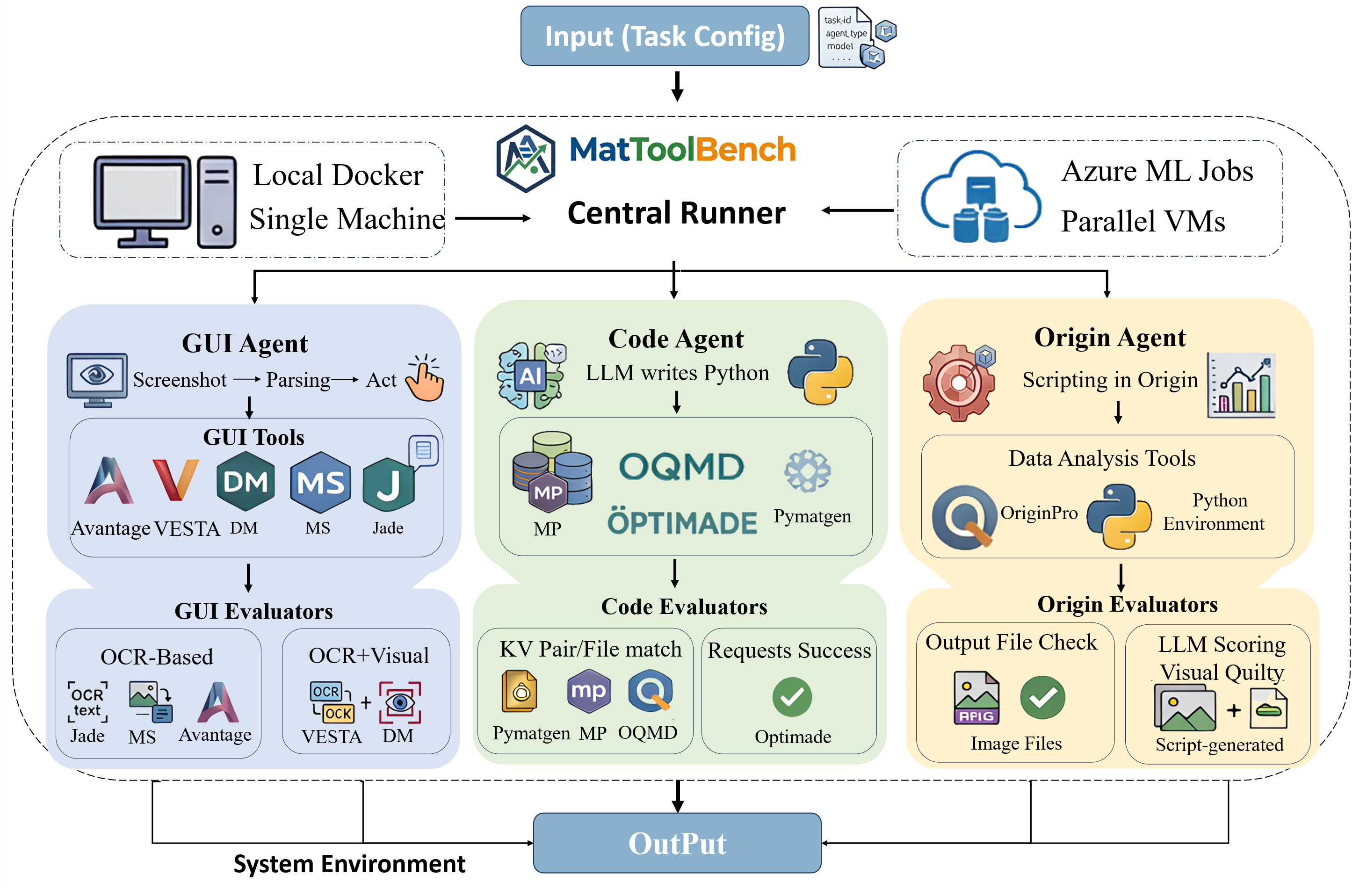
A real-environment benchmark with 204 tasks across 10 materials science tools, spanning GUI operation, OriginPro scripting, database queries, and diagnostic cross-tool workflows.
Problem
Multimodal agents are usually measured on general-purpose software, leaving a major gap in our understanding of how they perform in scientific tools and professional workflows.
Key Contributions
- Led the design of a benchmark spanning 204 tasks across 10 materials science tools and three interaction modalities.
- Built isolated Windows 11 execution environments with standardized reset and evaluation hooks.
- Helped define expert-guided partial-credit scoring and modality-specific evaluation for GUI states, exported figures, and database query outputs.
Results
- Evaluated seven multimodal models; the best GUI and code task success rates reached only 25% and 45%, respectively.
- Validated the GUI evaluation pipeline with an average F1 of 0.98.
- Identified failures in domain-specific workflow knowledge and cross-tool artifact handoff.
Benchmark scope
The 204 tasks comprise 100 GUI tasks, 16 OriginPro plotting tasks, 80 code-based database queries, and eight diagnostic mixed workflows. GUI tools include JADE, Avantage, VESTA, DigitalMicrograph, and Materials Studio; code tasks cover Materials Project, OQMD, OPTIMADE, and pymatgen.
Systems contribution
The benchmark is not only a task list. It also depends on a stable runner, environment reset logic, and evaluation interfaces that match the outputs of different software systems. I spent much of my effort on that systems layer so the benchmark could scale beyond manually curated demos.
Research value
The results show that success on general software benchmarks does not reliably transfer to scientific workflows. Failures involve specialized operational knowledge, sparse pretraining coverage, cross-tool artifact handoff, and critical software states exposed only visually.